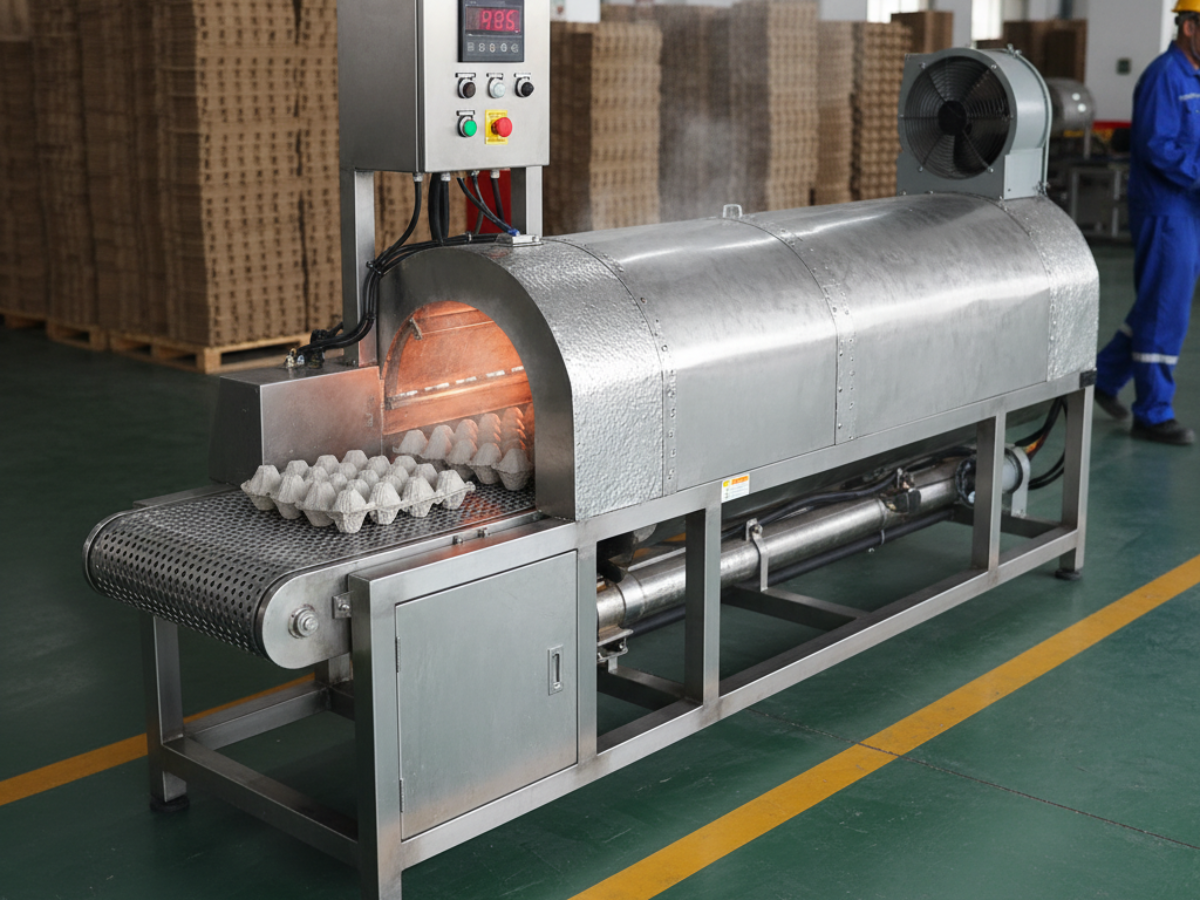
Small-scale egg tray manufacturers around the world constantly seek ways to improve productivity, reduce drying time, and increase product consistency. One frequently asked question is whether metal drying technology—drying systems that use metal-based conveyor ovens, metal plate dryers, or metal heat-exchange elements—can be integrated into small egg tray machines. This blog answers that question in detail, looking at feasibility, benefits, limitations, retrofit options, cost implications, and practical recommendations for manufacturers from Hyderabad to Hanoi and everywhere in between.
What is “metal drying technology” in the egg tray context?
Metal drying technology refers to drying solutions that use metal components (stainless steel conveyors, metal plate radiators, metal hot-air channels, or metal heated belts) to transfer heat more efficiently to molded pulp products. Compared with primitive sun-drying or simple brick/wood-fired tunnels, metal-based drying systems typically provide more uniform heat distribution, faster drying times, and easier process control.
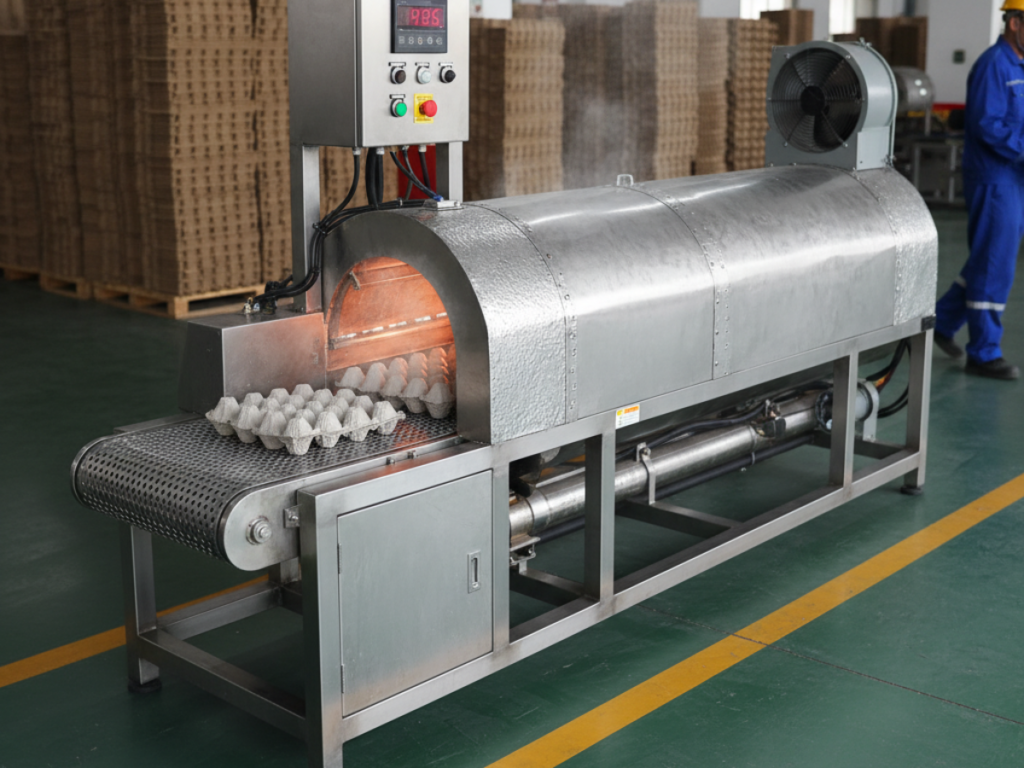
Can small egg tray machines use metal drying tech? — Short answer
Yes — in many cases. Small egg tray production lines can adopt metal drying components or be retrofitted with compact metal-based dryers. However, feasibility depends on machine layout, production scale, local fuel/energy availability, budget, and regulatory or safety constraints. The approach that works for a micro-factory producing a few hundred trays per hour will differ from a mid-sized plant producing thousands.
Benefits of adopting metal drying for small operations
- Faster turnaround times — Metal drying systems reach and maintain target temperatures more quickly than passive drying, shortening cycle times and increasing output per shift.
- Better product consistency — Controlled temperature and airflow reduce warping, cracking, and over-drying, improving tray quality.
- Smaller footprint vs. passive drying — Efficient metal heat exchangers can reduce the area needed for drying compared to large air-drying yards.
- Energy efficiency (long term) — Well-designed metal systems can lower per-tray energy usage through insulation, recuperation, and precise controls.
- Scalability — Metal dryers can be modular — start small and add modules as production grows.
Typical limitations and considerations
- Initial cost — Even compact metal dryers cost more upfront than open-air or basic tunnel dryers. Small businesses must weigh capex vs. faster ROI from increased throughput.
- Energy source — Metal dryers typically require a reliable fuel or electricity source. In regions with expensive power, fuel choices (biomass, LPG, diesel, electricity) affect operating cost.
- Integration complexity — Aligning a metal dryer’s conveyor speed, temperature zones, and airflow with existing moulders and presses needs careful engineering.
- Maintenance — Metal systems require periodic checks (belts, bearings, burners, electrical controls). Local access to spare parts and technicians matters.
- Safety & regulations — Hot metal surfaces, burners, and electrical systems require safety measures and, in some countries, inspections or permits.
Practical retrofit options for small egg tray machines
- Modular hot-air tunnel (compact)
- Small tunnel dryer that sits after the moulding press. Uses metal panels, a compact fan, and a heat source (electric or burner). Easy to add to existing lines.
- Ideal for producers who want a stepped improvement without reworking the whole line.
- Metal heated conveyor plates
- Heated stainless-steel plates or belts that transfer heat directly. Useful for very compact setups where trays pass slowly across heated surfaces.
- Works best with careful speed and temperature control to avoid scorching.
- Cabinet/box dryers with metal heat-exchangers
- Vertical or horizontal cabinets with blown hot air and metal ducts. Great for batch drying small lots and for producers who prefer batch processing to continuous lines.
- Hybrid systems (solar-assisted + metal backup)
- In sunny regions, combine solar air heaters with metal heat exchangers for evening/night operation. Lowers fuel costs and improves sustainability.
Cost & ROI — what to expect
- CapEx range — Very approximate: small modular metal dryers for micro-lines can start at a few thousand USD and scale up depending on capacity and automation.
- Operating cost drivers — Energy price, local labor, maintenance intervals, and dryer efficiency.
- ROI timeline — With increased throughput and reduced drying losses, many small producers see payback in 12–36 months, but this varies widely by region and production volume.
Best practices when implementing metal drying
- Match capacity — Size the dryer to your average production, not peak-only output. Oversizing wastes capital and energy.
- Test in small increments — Start with a single module or cabinet to validate drying profiles before full rollout.
- Focus on airflow uniformity — Heat without consistent airflow causes uneven drying; use baffles and calibrated fans.
- Use proper insulation — Insulation reduces heat loss and operating cost.
- Train staff — Safe operation and routine maintenance extend equipment life and ensure product quality.
- Consider local serviceability — Choose designs with widely available spare parts and technicians in your region.
Real-world use cases (generalized)
- A family-owned plant in Southeast Asia retrofitted a compact hot-air tunnel and doubled daily output while reducing breakage.
- A small European producer combined a metal cabinet dryer with a dehumidifier to maintain consistent quality through the humid season.
- A start-up in Africa used a solar-assisted hot-air system with metal ducts to cut fuel costs by about 40% while keeping drying times competitive.
Environmental and sustainability angle
Metal drying systems can actually support greener production when coupled with efficient burners, waste-heat recovery, or renewable energy (solar or biomass). Reduced rework and lower breakage also decrease material waste — a key advantage for eco-conscious brands and buyers.
Conclusion — is it right for you?
For many small egg tray manufacturers worldwide, metal drying technology is a viable and often beneficial step forward. It increases throughput, improves product quality, and—when designed well—reduces per-unit energy use. The decision should rest on a careful analysis of production volume, energy costs, available capital, and local serviceability. Most successful small-scale implementations are modular, conservative in initial investment, and designed with easy maintenance in mind.