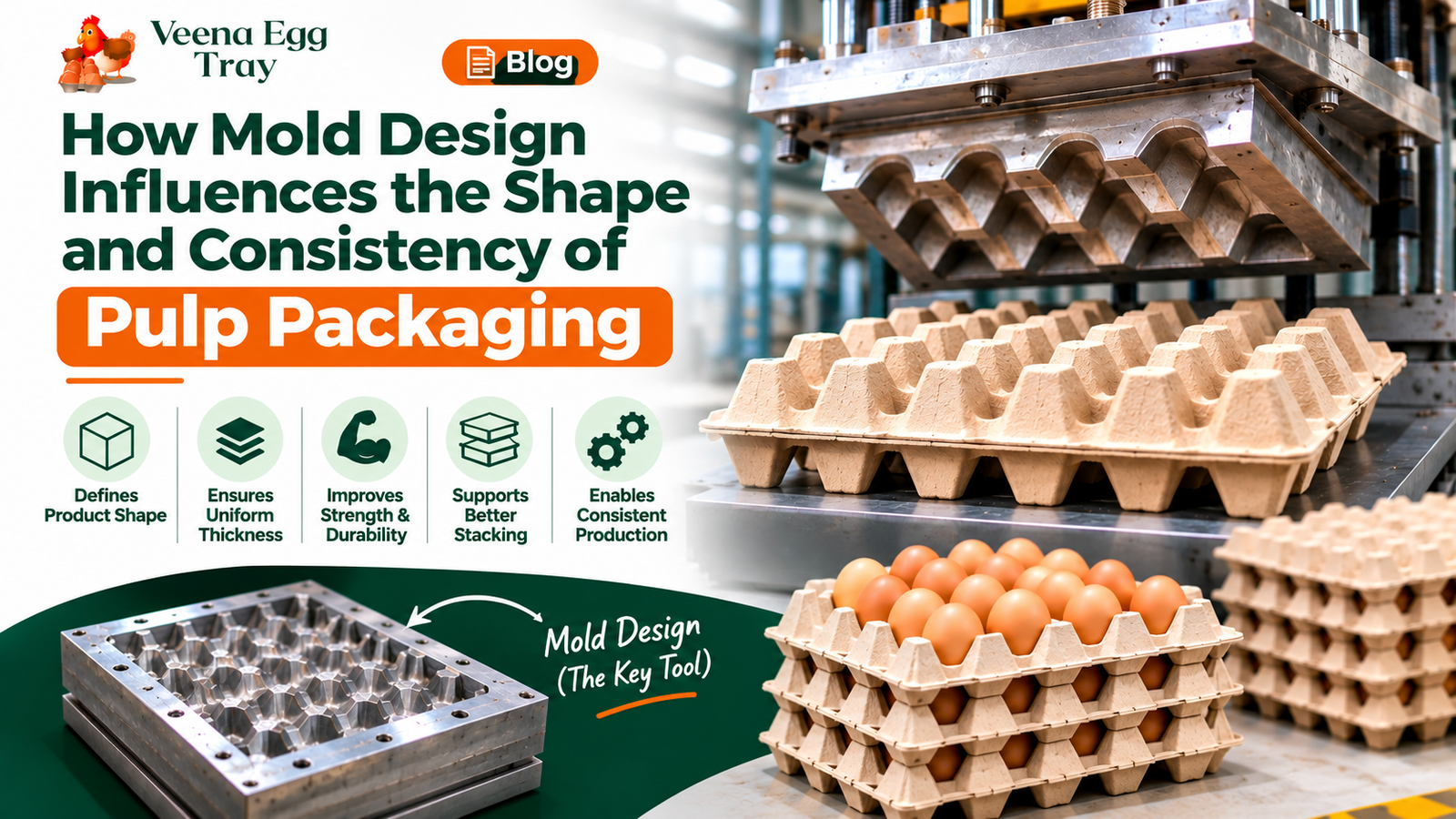
Molded pulp packaging is widely used for egg trays, protective packaging, fruit trays, and various industrial packaging applications. Its quality depends on several factors, including raw material, pulp consistency, moisture content, production methods, and equipment. Among these factors, pulp packaging mold design plays a particularly important role in determining the final product’s shape, dimensions, surface finish, and structural consistency.
A properly designed mold helps manufacturers produce packaging with uniform compartments, consistent wall thickness, and suitable structural support. For businesses manufacturing paper egg trays and other molded pulp products, understanding mold design is essential for maintaining product quality and improving production efficiency.
In this article, we explore how mold design influences the shape and consistency of pulp packaging and why it matters in commercial manufacturing.
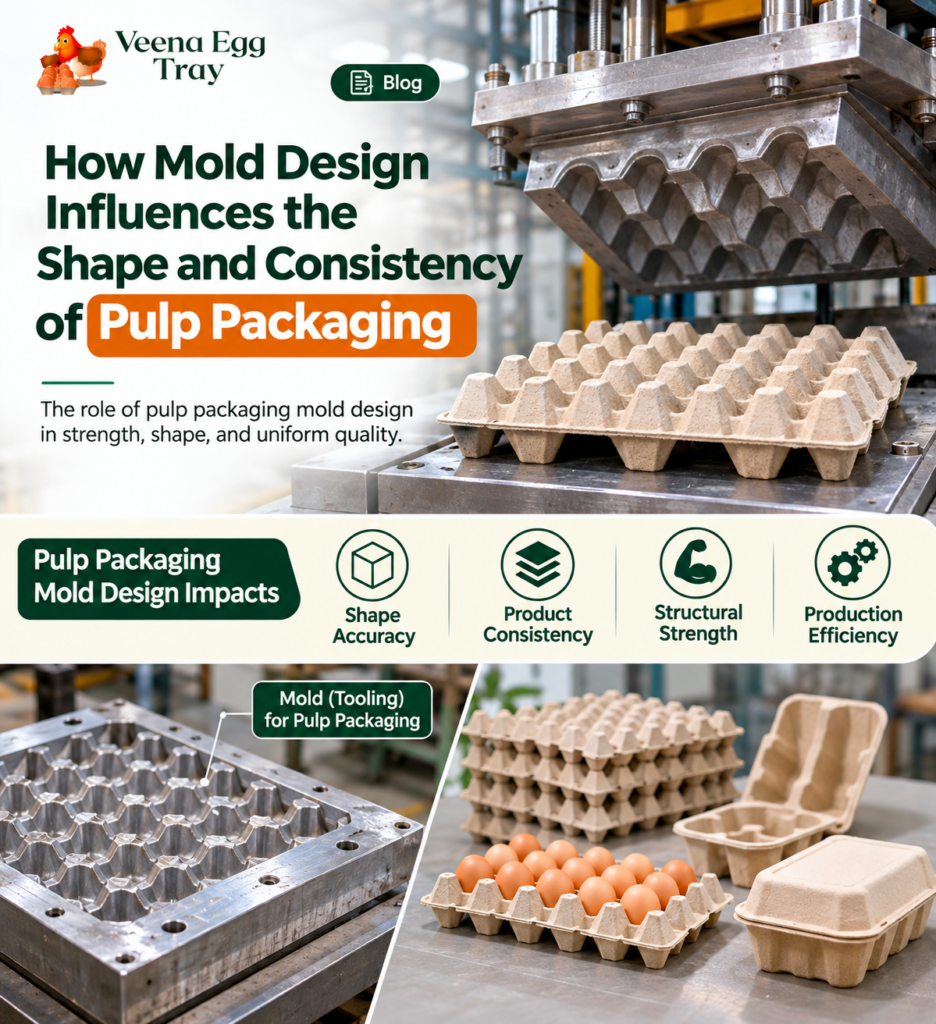
What Is Pulp Packaging Mold Design?
Pulp packaging mold design is the process of developing the tooling used to shape wet paper pulp into a finished packaging product.
During manufacturing, prepared pulp is distributed over a specially designed mold. Water is removed through drainage and vacuum systems, allowing the pulp fibers to form the required shape. The molded product is then transferred for drying and finishing.
The mold determines several important product characteristics:
- Overall product dimensions and shape.
- Compartment depth and spacing.
- Wall thickness distribution.
- Surface texture and finish.
- Structural support and rigidity.
- Stacking and fitting characteristics.
For example, an egg tray mold must accommodate individual egg compartments, supporting walls, and appropriate spacing. These features influence how the finished tray holds and separates eggs.
1. Mold Geometry Determines Product Shape
The geometry of a mold directly influences the shape of the final pulp packaging product.
Every curve, corner, depression, and raised section in the mold contributes to the final structure. If the mold dimensions are not designed correctly, the finished product may have irregular compartments, inconsistent edges, or dimensional variations.
For egg trays, mold geometry is particularly important because each compartment needs to maintain a consistent shape and spacing.
A well-planned mold design considers:
- Compartment dimensions.
- Wall angles and curves.
- Corner radii.
- Product height and depth.
- Overall length and width.
- Edge and rim structure.
Accurate geometry helps manufacturers maintain uniformity across repeated production cycles.
2. Drainage Design Influences Pulp Distribution
Water removal is a critical part of molded pulp manufacturing. Drainage holes and channels allow excess water to move away from the pulp during the forming process.
If drainage is poorly distributed, some sections of the mold may retain more water than others. This can contribute to uneven pulp deposition and differences in wall thickness.
Effective drainage design considers:
- Drainage hole placement.
- Hole size and distribution.
- Water flow pathways.
- Vacuum performance.
- Pulp movement across the mold surface.
For consistent production, drainage should be evaluated alongside pulp concentration, vacuum pressure, and forming time.
3. Wall Thickness Affects Strength and Consistency
Wall thickness is one of the important characteristics of pulp packaging. Uneven thickness can lead to differences in rigidity, weight, and structural performance.
Mold geometry, drainage patterns, pulp flow, and vacuum conditions all influence how fibers accumulate across the mold surface.
A suitable mold design aims to support consistent pulp distribution in areas that require structural strength.
For egg trays, important areas include:
- Individual egg compartments.
- Supporting walls between compartments.
- Outer edges and rims.
- Base contact points.
- Stacking support sections.
The goal is not necessarily to make every section equally thick. Instead, thickness should be appropriate for the function of each section while maintaining consistent product quality.
4. Mold Surface Quality Influences Product Finish
The surface condition of the mold can influence the appearance and texture of finished pulp packaging.
Damaged, contaminated, or poorly maintained mold surfaces may affect pulp release and contribute to surface irregularities.
Manufacturers should pay attention to:
- Mold surface smoothness.
- Perforation quality.
- Surface cleanliness.
- Wear and tear.
- Maintenance and inspection frequency.
Regular cleaning and maintenance help preserve mold performance and support consistent production.
5. Mold Design Supports Better Stacking and Storage
Stackability is an important consideration in commercial packaging manufacturing. Egg trays and other pulp products are often stacked for storage, handling, and transportation.
If the mold design does not account for stacking requirements, finished products may fit poorly or become difficult to separate.
A suitable design should consider:
- Nesting depth.
- Supporting edges.
- Product height.
- Alignment between stacked units.
- Ease of separation.
- Stability during storage.
For egg tray manufacturers, consistent stacking geometry can help businesses organize packaging inventory and manage transportation more efficiently.
6. Material Selection and Mold Design Must Work Together
Mold design alone does not determine the final quality of pulp packaging. The characteristics of the raw material also influence product formation.
Different paper fibers can have different properties, including fiber length, water absorption, drainage behavior, and bonding characteristics.
Manufacturers should evaluate mold design alongside:
- Pulp composition.
- Fiber quality.
- Pulp concentration.
- Moisture content.
- Additives, where applicable.
- Forming and drying conditions.
A mold that performs well with one pulp formulation may require adjustments when the raw material changes.
7. Mold Design Influences Production Efficiency
An effective mold design can support more consistent production and reduce avoidable manufacturing issues.
Poorly designed tooling may contribute to uneven formation, difficult product release, excessive material use, or frequent quality adjustments.
Manufacturers should evaluate the following areas:
Forming performance: Does the mold distribute pulp consistently across the product surface?
Drainage efficiency: Can excess water be removed effectively?
Product release: Can the formed product transfer from the mold without unnecessary damage?
Cycle consistency: Does the tooling support repeatable results across production cycles?
Maintenance requirements: Is the mold easy to clean, inspect, and maintain?
These factors help manufacturers evaluate the overall effectiveness of their tooling.
Common Mold Design Problems in Pulp Packaging Manufacturing
Some common issues that manufacturers should monitor include:
| Mold design issue | Possible production impact |
|---|---|
| Uneven drainage | Inconsistent pulp distribution |
| Incorrect compartment geometry | Irregular product shape |
| Poor surface condition | Surface defects and release issues |
| Inadequate venting | Uneven forming performance |
| Incorrect stacking geometry | Poor nesting and storage |
| Mold wear | Dimensional variation over time |
Identifying these issues early can help manufacturers improve their production process and maintain product consistency.
How to Improve Pulp Packaging Mold Design
Manufacturers can follow a structured approach when developing or improving molds.
- Define product requirements: Establish the required dimensions, weight, strength, and intended application.
- Develop accurate geometry: Design compartments, edges, curves, and supporting sections according to the product specification.
- Optimize drainage: Evaluate drainage hole distribution and water flow.
- Test pulp distribution: Examine wall thickness and fiber formation across different product sections.
- Evaluate product release: Check whether the molded product transfers without damage.
- Conduct production trials: Test repeatability under actual manufacturing conditions.
- Inspect and maintain tooling: Regularly monitor mold condition and clean surfaces.
A combination of design validation, production testing, and maintenance is important for achieving consistent results.
Why Pulp Packaging Mold Design Matters for Egg Tray Manufacturers
Egg trays are among the widely recognized applications of molded pulp packaging. Their design includes individual compartments, supporting structures, and stacking features that help organize eggs.
For manufacturers such as Veena Egg Tray, mold design is an important technical consideration when evaluating product shape, compartment consistency, and manufacturing quality.
A suitable mold should support the required tray dimensions and allow consistent formation under controlled production conditions.
As demand for paper-based packaging continues to develop, manufacturers need to pay attention to tooling quality, raw material selection, and process control to maintain reliable production standards.
Frequently Asked Questions
1. What is pulp packaging mold design?
Pulp packaging mold design is the development of tooling used to shape wet paper pulp into products such as egg trays, protective inserts, and other molded packaging.
2. How does mold design affect pulp packaging quality?
Mold design influences product dimensions, compartment geometry, wall thickness distribution, drainage, surface finish, and stacking characteristics.
3. Why is drainage important in pulp packaging molds?
Drainage allows excess water to leave the pulp during forming. Proper drainage distribution supports more consistent fiber formation and product thickness.
4. Does mold design affect egg tray strength?
Yes. Mold geometry influences supporting walls, compartment shapes, and structural features. However, final strength also depends on pulp composition, fiber bonding, drying, and production conditions.
5. What causes inconsistent pulp packaging shapes?
Possible causes include inaccurate mold dimensions, uneven drainage, inconsistent pulp concentration, vacuum variations, mold wear, and changes in forming conditions.
6. How often should pulp packaging molds be maintained?
Maintenance frequency depends on production volume, mold material, operating conditions, and manufacturer recommendations. Regular cleaning and inspection help identify wear and drainage problems.
7. Can mold design reduce material wastage?
An optimized mold can help improve pulp distribution and reduce avoidable defects. Actual material savings depend on tooling, raw materials, and production process control.
Conclusion
Pulp packaging mold design is a fundamental part of molded pulp manufacturing. It influences product geometry, drainage, wall thickness, surface finish, stacking performance, and production consistency.
For manufacturers producing paper egg trays and other molded pulp products, investing in accurate mold development, regular maintenance, and production testing can help improve manufacturing quality.
At Veena Egg Tray, understanding the role of mold design helps highlight the technical considerations behind producing consistent paper egg tray packaging.
The right mold design is an important foundation for reliable and consistent pulp packaging production.